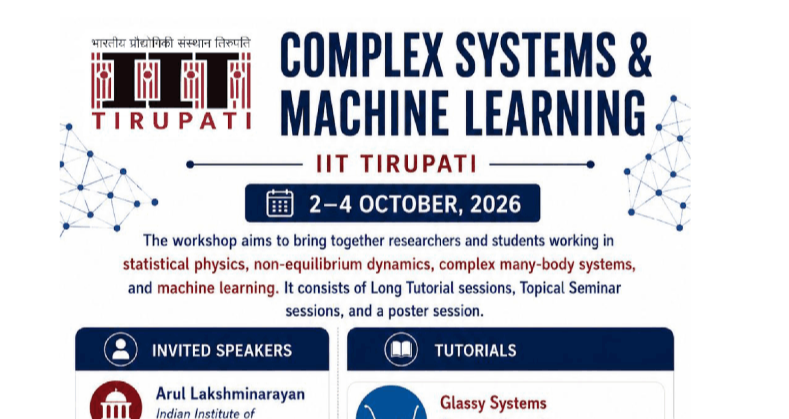
Discover how machine learning is transforming the study of complex physical systems. This three-day workshop at IIT Tirupati will feature expert tutorials, invited talks, and a poster session covering glassy systems, quantum chaos, thermalization, and AI-driven scientific research. Meet renowned researchers, exchange ideas, and explore cutting-edge developments at the intersection of physics and machine learning. Register today!

Join us for the Weekly Seminar Series at the Department of Physics, held Thursday at 15:30 hrs. Each session features expert speakers discussing the latest research, innovations, and trends in their respective field. Open to students, faculty, and researchers, these seminars foster learning, collaboration, and insightful discussions.
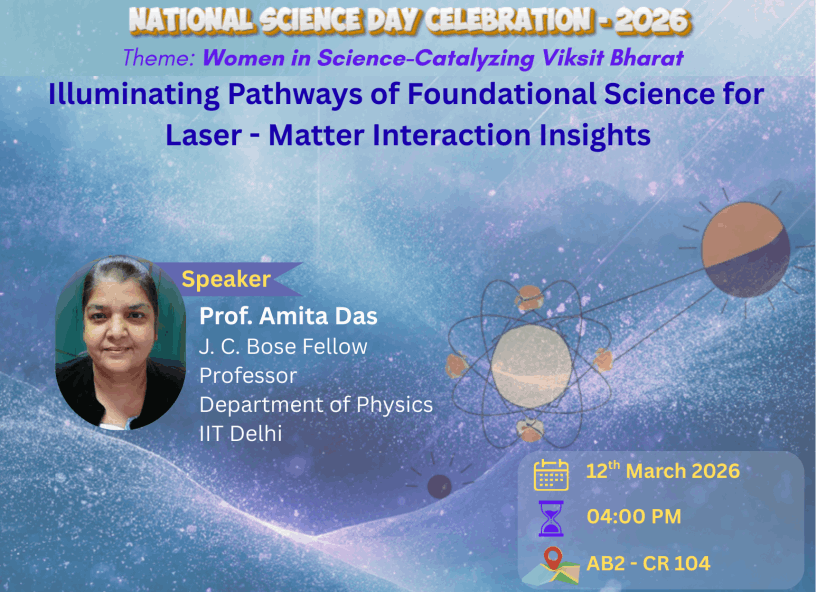
The Department of Physics at IIT Tirupati is pleased to invite you to a Popular Science Lecture organized as part of the National Science Day 2026 celebrations. This year’s celebration is aligned with the theme “Women in Science – Catalyzing Viksit Bharat.”
The event is open to all students, faculty members, and researchers, and aims to foster learning, collaboration, and insightful discussions within the scientific community.
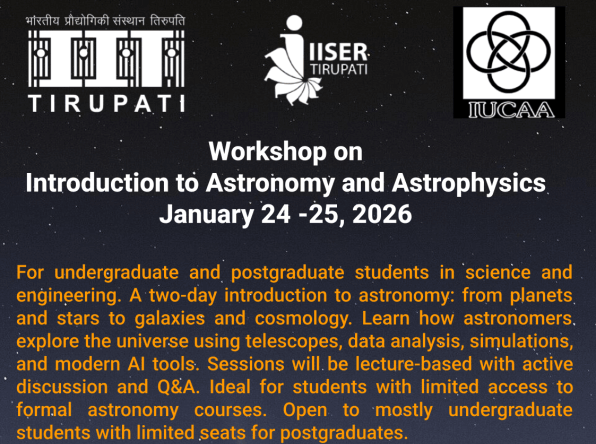
For undergraduate and postgraduate students in science and engineering. A two-day introduction to astronomy: from planets and stars to galaxies and cosmology. Learn how astronomers explore the universe using telescopes, data analysis, simulations, and modern AI tools. Sessions will be lecture-based with active discussion and Q&A. Ideal for students with limited access to formal astronomy courses. Open to mostly undergraduate students with limited seats for postgraduates.
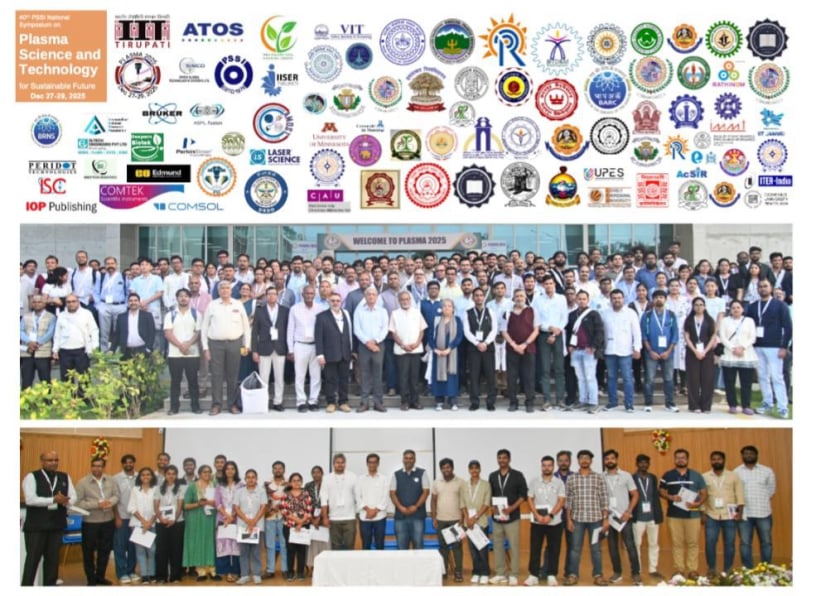
The Departments of Physics and Civil & Environmental Engineering at IIT Tirupati jointly organized the 40th National Symposium on Plasma Science and Technology from 27–29 December 2025. The event attracted around 400+ delegates from academic institutions and research organizations across India, along with a few international participants, reflecting strong engagement from the plasma science community.

The 2025 Nobel Prize in Physics was awarded to John Clarke, Michel H. Devoret, and John M. Martinis "for the discovery of macroscopic quantum mechanical tunnelling and energy quantisation in an electric circuit". The three formed a team comprising a professor, a postdoctoral researcher, and a graduate student at the time their groundbreaking experiments were performed. In this talk, I will present an overview of the macroscopic quantum tunnelling experiments using Josephson junctions. I will also highlight how an effort to answer a fundamental question in physics ultimately laid the foundation for today’s large-scale quantum processors based on superconducting qubits.
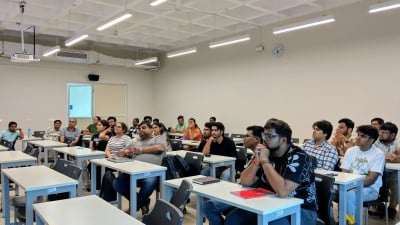
Department of Physics welcomes newly admitted B.Tech., M.Sc., and PhD students. Congratulations for your achievement. This is a place where ideas grow, curiosity is encouraged, and learning never stops.
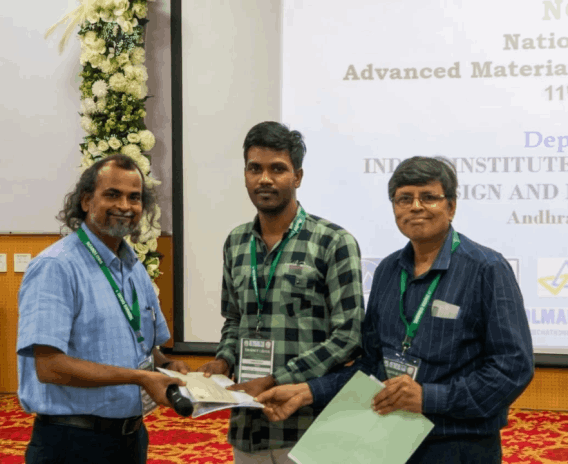
The Department of Physics proudly congratulates Mr. Rama Chandra Moharana on receiving the Best Oral Presentation Award at the National Conference on Advances in Materials Science and Technology (NCAMST-2026) held at the Indian Institute of Information Technology, Design and Manufacturing (IIITDM), Kurnool. His outstanding presentation showcased innovative research contributions and demonstrated exceptional scientific communication skills.

The Department of Physics proudly congratulates Dr. Smita Rani Mishra on successfully defending their PhD thesis! This achievement is a testament to your hard work, dedication, and passion for research. We celebrate your success and look forward to your future contributions!

Our BTech programme in Engineering Physics has emerged as the most rapidly expanding branch at Indian Institute of Technology Tirupati, underscoring a notable shift toward interdisciplinary scholarship and research-intensive career pathways.

We’re delighted to welcome our new faculty member Dr. Kolla Lakshmi Ganapathi to the Department of Physics! Dr. K. L. Ganapathi’s research experience is at the intersection of physics and engineering of advanced semiconductors. His research focuses on physics and technology of nanoscale devices for emerging applications encompassing electronic (logic and memory), optoelectronics, and quantum technologies.
We look forward to collaborating and achieving great things together. Here’s to an exciting journey ahead!

We’re delighted to welcome our new faculty member Dr. Avinash Patsha to the Department of Physics! His research interests include 2D Quantum Materials and Devices, Semiconductor Nanostructures and Quantum optoelectronics, Novel growth methods for 2D quantum materials and heterostructures, Semiconductor nanostructures for energy efficient devices, Light-matter interactions and exciton physics, and Light-driven devices for quantum technologies.
We look forward to collaborating and achieving great things together. Here’s to an exciting journey ahead!
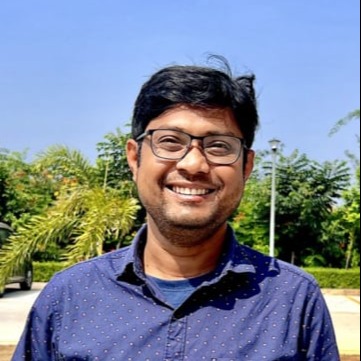
Congratulations to Dr. Kapildeb Dolui on receiving the prestigious Distinguished Young Scientist Award at ICLED-2025 in Singapore — a truly outstanding recognition of his exceptional contributions!

The Department of Physics proudly congratulates Dr. Vaibhav Kumar Singh on successfully defending their PhD thesis! This achievement is a testament to your hard work, dedication, and passion for research. We celebrate your success and look forward to your future contributions!
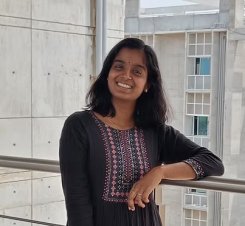
The Department of Physics proudly congratulates Dr. Indu Suresh on successfully defending their PhD thesis! This achievement is a testament to your hard work, dedication, and passion for research. We celebrate your success and look forward to your future contributions!
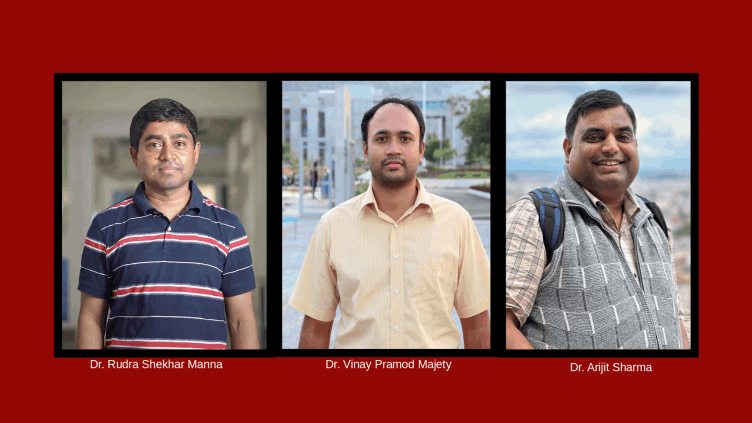
Congratulations to Dr. Rudra, Dr. Vinay and Dr. Arijit on their well-earned promotion to Associate Professor.
This achievement reflects their dedication to excellence in research, teaching, and service.
Their contributions to Department and their respective field have been invaluable to our academic community.
We extend our best wishes for continued success in their future endeavors.
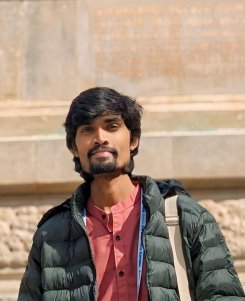
The Department of Physics proudly congratulates Dr. Hareesh C on successfully defending their PhD thesis! This achievement is a testament to your hard work, dedication, and passion for research. We celebrate your success and look forward to your future contributions!
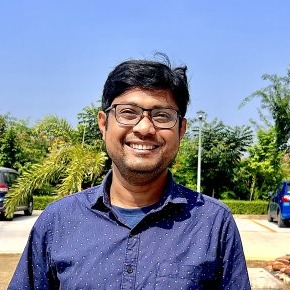
We’re delighted to welcome our new faculty member Dr. Kapilldeb Dolui to the Department of Physics! His research experience is in the areas of computational materials physics, specifically studying of physical properties of large classes of quantum materials using first-principles methodologies. We look forward to collaborating and achieving great things together. Here’s to an exciting journey ahead!
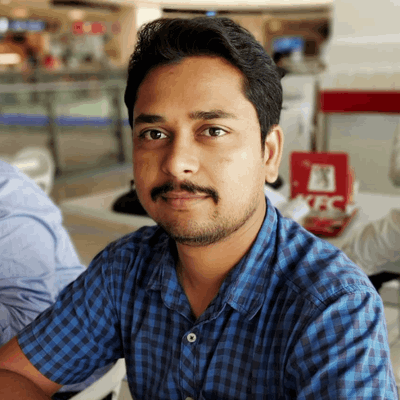
We’re delighted to welcome our new faculty member Dr. Vikram Khaire to the Department of Physics! His primary research area is astrophysics, with a focus on the intergalactic medium - the vast space between galaxies - which contains over 90% of the ordinary matter in the universe. We look forward to collaborating and achieving great things together. Here’s to an exciting journey ahead!