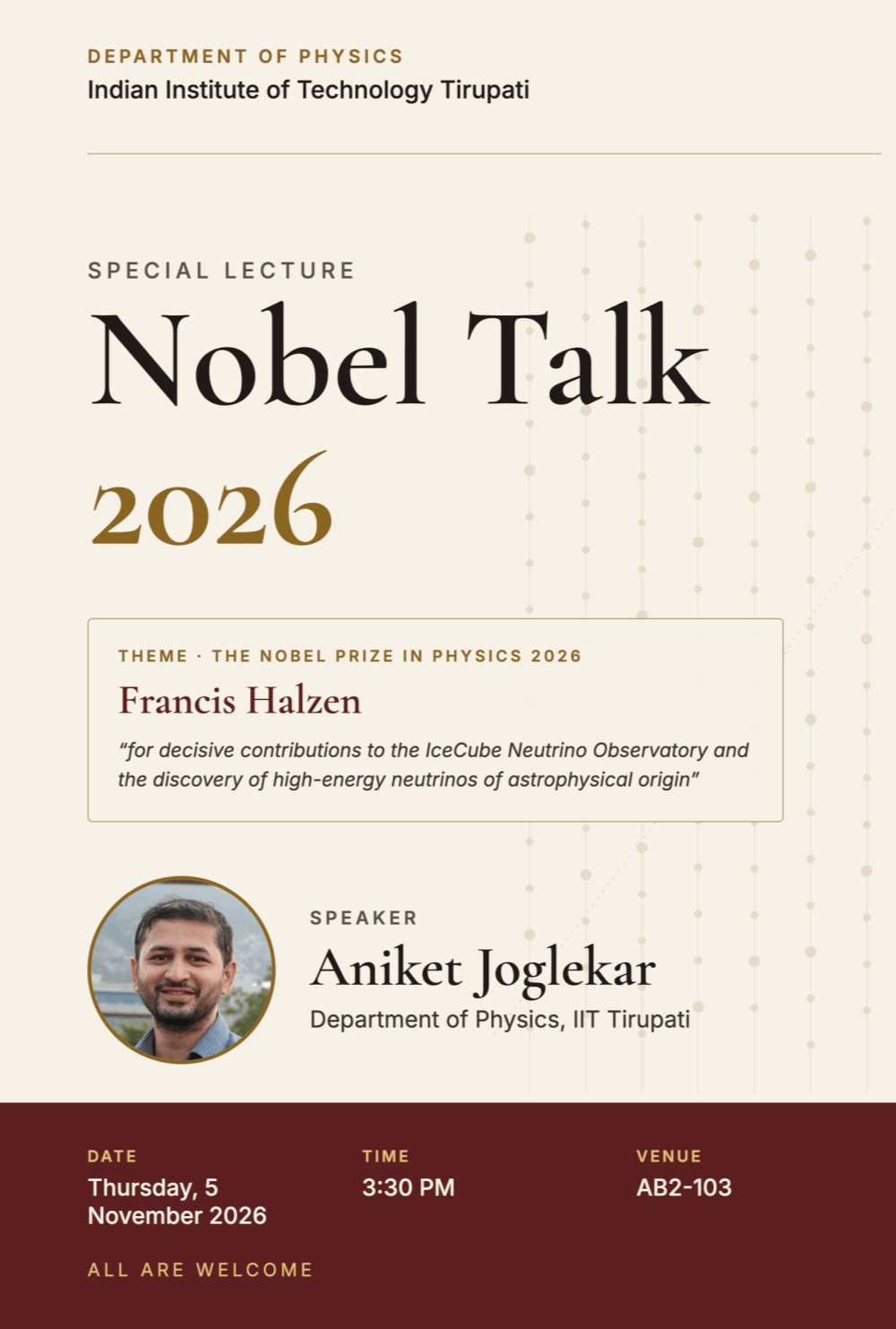
Physics Colloquium


Prof. Aniket Joglekar


Space-Time: AB2 - CR 103; November 05, 2026 @ 15:30 hrs


The 2026 Nobel prize
in physics

The 2026 Nobel Prize in Physics, awarded to Francis Halzen for his contributions to the IceCube Neutrino Observatory and the discovery of high-energy astrophysical neutrinos, highlights a major advancement in understanding the universe.

Neutrinos are elusive subatomic particles that interact weakly with matter and travel vast cosmic distances. At the South Pole, IceCube uses thousands of optical sensors embedded in Antarctic ice to detect faint flashes of light produced by neutrino interactions. This pioneering research has established neutrino astronomy, opening new avenues to investigate extreme cosmic environments, supermassive black holes, and cosmic particle acceleration. By complementing conventional astronomical observations, it offers unique insights into the universe's most energetic phenomena and advances our understanding of fundamental particles, astrophysics, and the cosmos.

About the speaker

Dr. Aniket Joglekar is an Assistant Professor in the Department of Physics at the Indian Institute of Technology Tirupati (IIT Tirupati). He is a theoretical physicist whose research explores fundamental questions in particle physics, dark matter, and the early universe.

His work addresses some of the most intriguing mysteries of modern physics: the nature of dark matter, the origin of the matter–antimatter asymmetry in the universe, and the possibility of new particles and physical phenomena beyond the Standard Model of particle physics.

By connecting theoretical particle physics with astrophysics and cosmology, Dr. Joglekar's research aims to deepen our understanding of the fundamental constituents of matter, the laws governing their interactions, and the evolution of the universe.


Prof. Vibhor Singh 


Space-Time: AB2 - CR 104; November 27, 2025 @ 16:00 hrs


The 2025 Nobel prize
in physics

The 2025 Nobel Prize in Physics was awarded to John Clarke, Michel H. Devoret, and John M. Martinis "for the discovery of macroscopic quantum mechanical tunnelling and energy quantisation in an electric circuit". The three formed a team comprising a professor, a postdoctoral researcher, and a graduate student at the time their groundbreaking experiments were performed. In this talk, I will present an overview of the macroscopic quantum tunnelling experiments using Josephson junctions. I will also highlight how an effort to answer a fundamental question in physics ultimately laid the foundation for today’s large-scale quantum processors based on superconducting qubits.

About the speaker

Prof. Vibhor Singh is an Associate Professor in the Department of Physics at the Indian Institute of Science (IISc), Bengaluru. He earned his PhD from the Tata Institute of Fundamental Research and completed a postdoctoral stint at TU Delft in the Netherlands. Since joining IISc in 2015, his research has focused on cavity-optomechanics, superconducting quantum circuits, nano mechanics, and low-dimensional electron transport. Prof. Singh also contributes to India’s National Quantum Mission through his work on superconducting qubit systems.


Prof. Joseph Samuel


Space-Time: LHC-CR001; August 19, 2025 @ 17:15 hrs


Relativity and Navigation

The stories of Time, Relativity and Navigation are inextricably linked. This talk will bring out the history and physics of the connections. We will see that the practical problem of navigation led to better clocks, and a better understanding of Time and the behavior of Light. These developments fed into the Theory of Relativity and culminated in the Global Positioning system (GPS), which we now routinely use today to find our way.

About the speaker

Prof. Joseph Samuel is a theoretical physicist with an interest in popularising Science. His interests are in geometry and topology in physics. He likes to keep in touch with mathematics as well as experiments. He studied physics at IIT Kanpur and at the IISc, Bangalore and then joined the Raman Research Institute. He is now at the International Centre for Theoretical Sciences (ICTS), Bangalore and contributes to the outreach effort, teaching and research.


Address:

Department of Physics
IIT Tirupati 
INDIA - 517 619
Email: ph_office@iittp.ac.in
Ph: 0091-877-250-3451


© Department of Physics, IIT Tirupati - 517 619 (INDIA)