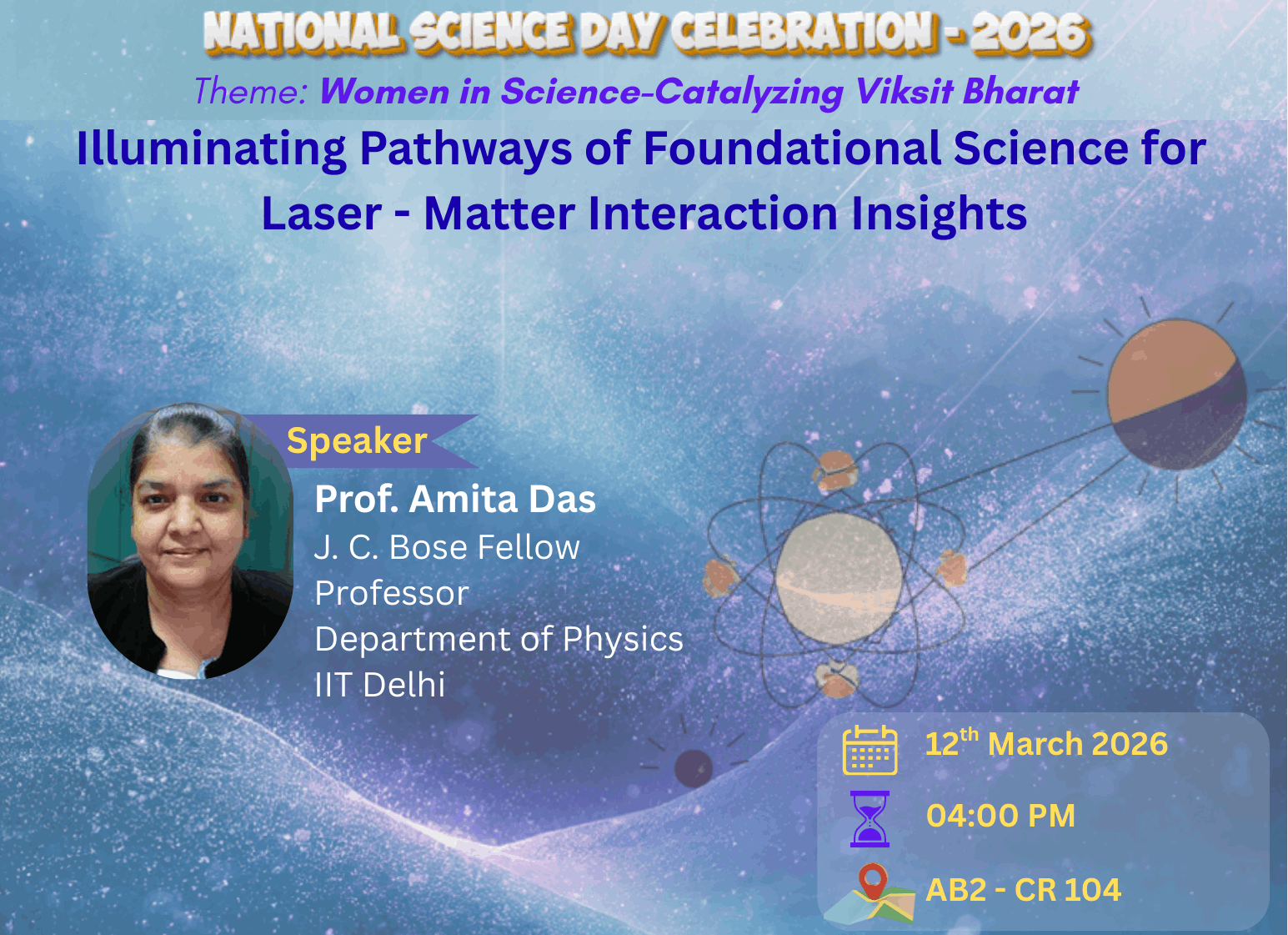
March 12, 2026
Fundamental concepts introduced early in physics education often continue to guide our understanding of the most complex physical systems. In this talk, we revisit two such pillars of classical physics—pendulum oscillations and Maxwell’s equations—which form an integral part of the science curriculum from the senior secondary level onward. While these ideas are typically encountered in simplified contexts, they also provide powerful conceptual frameworks for understanding energy transfer and dynamical evolution in complex physical systems.
The talk will illustrate how these foundational principles, when appropriately extended and applied, can offer valuable guidance for achieving efficient energy transfer processes, an objective that underpins many modern technological applications. In essence, we seek to address a broader scientific question: how can complex systems be steered toward efficient and desirable outcomes?
In the context of laser matter interactions, this question becomes both fundamentally important and technologically relevant. Can intense laser–plasma coupling be controlled to efficiently generate energetic particle beams, heat plasmas for fusion applications, or produce high-frequency radiation? Addressing these challenges requires a deeper understanding of collective plasma dynamics, nonlinear wave interactions, and wave-breaking phenomena that govern energy flow in such systems.
The talk will also explore emerging regimes of interaction between intense electromagnetic waves and magnetized plasmas, revealing rich and sometimes unexpected physical behavior. In particular, an intriguing regime will be discussed in which electromagnetic waves can propagate through plasma in a vacuum-like manner, offering new insights into wave–medium interactions.
By connecting frontier research in high-intensity laser–plasma physics with the fundamental ideas that students first encounter in classical mechanics and electromagnetism, this talk aims to highlight how foundational science continues to illuminate pathways toward both technological innovation and deeper physical understanding.
Prof. Amita Das is a distinguished Indian plasma physicist whose research spans laser-plasma interactions, nonlinear plasmas, plasma turbulence, and the properties of strongly coupled and dusty plasma systems. With over 150+ publications in peer-reviewed international journals, she has made significant contributions to the field and guided numerous students to earn their Ph.Ds under her mentorship.
Prof. Das earned her Ph.D. from the Indian Institute of Technology (IIT), Kanpur, in 1990. Following her graduation, she joined the Institute for Plasma Research (IPR), where she held various positions, including Dean of the Institute. In December 2018, she transitioned to the Physics Department of the Indian Institute of Technology Delhi, where she continues her impactful work.
She is a fellow of all three prestigious Indian academies: INSA (Delhi), IAS (Bangalore), and NASI (Allahabad). Prof. Das is also a recipient of the J.C. Bose Fellowship Award from the Department of Science and Technology (DST) and the Kaw Legacy Award conferred by the Kaw Family Trust.
Her contributions extend beyond research and teaching to academic leadership. She has held editorial roles for several international journals, including Physics Letters A, Fundamental Plasma Physics and Reviews of Modern Plasma Physics. Currently, she serves as the secretary of the C:16 Commission of the International Union of Pure and Applied Physics (IUPAP).
Date: Thursday, 12th March 2026
Time: 4:00 PM – 5:00 PM
Venue: AB2 – CR 104, IIT Tirupati